
How Much Income Do You Need to Buy a Home in Langley in 2026?Updated September 25, 2026. All amounts are in Canadian dollars.How much do you need to earn to buy a home in Langley? Under the examples

Dated: September 25 2026
Views: 5
Updated September 25, 2026. All amounts are in Canadian dollars.
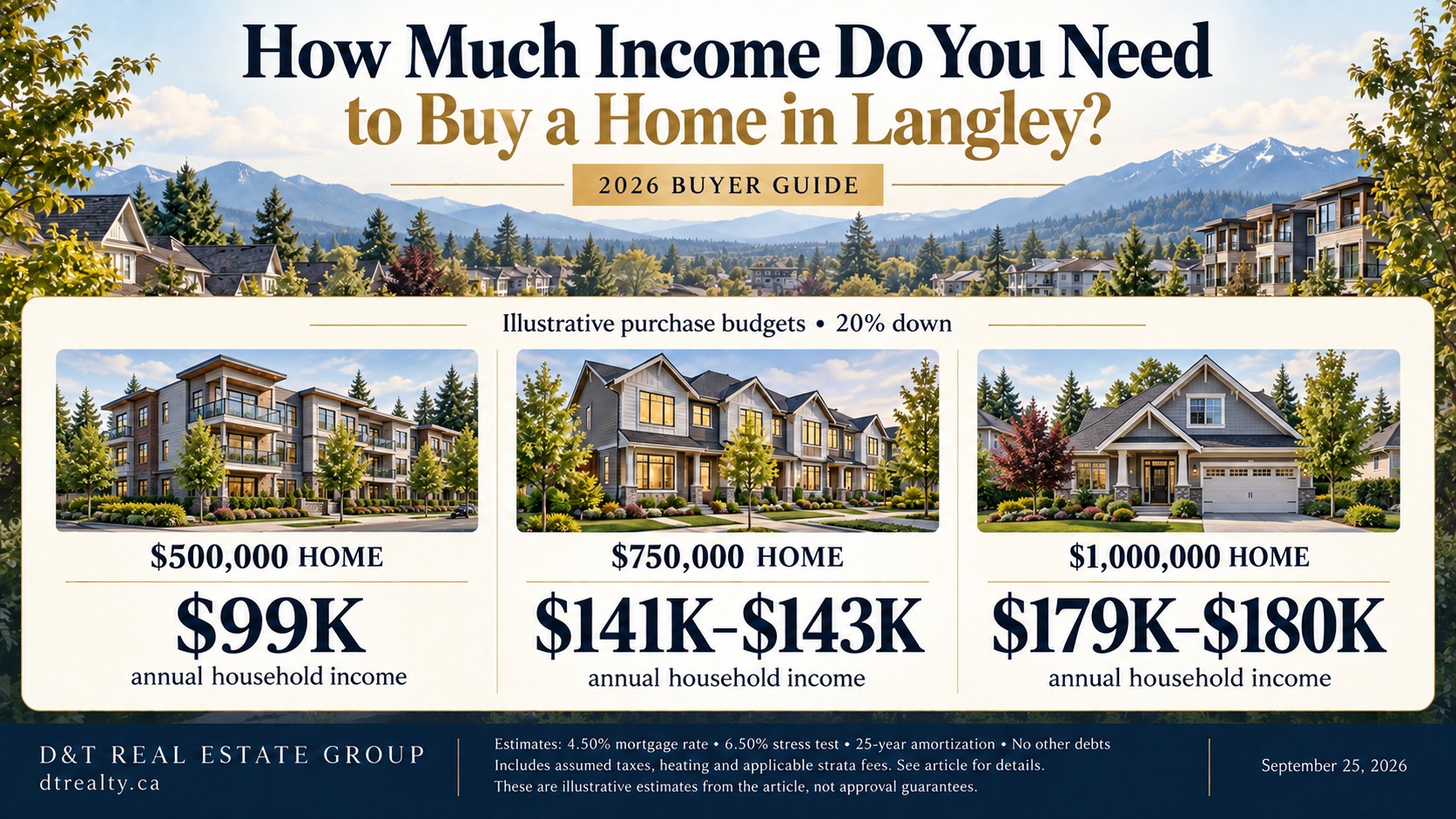
How much do you need to earn to buy a home in Langley? Under the examples in this guide, a household buying a $500,000 condo with 20% down needs approximately $99,000 in annual gross income. A $750,000 townhouse requires approximately $141,000–$143,000, while a $1 million home without strata fees requires approximately $179,000–$180,000.
Those figures change with your mortgage rate, down payment, debts, property taxes and strata fees. They are estimates of mortgage qualification not a recommendation to spend your maximum approved amount.
Your search area matters, too. A condo in Langley City, a townhouse in Willoughby and a detached home in Brookswood come with different ownership costs and maintenance responsibilities.
Working with an experienced Langley realtor can help you connect your financing budget with suitable properties and neighbourhoods.
As of September 25, 2026, Ratehub’s Canadian comparison pages advertised the following starting rates:
| Mortgage product | Advertised starting rate |
|---|---|
| Five-year fixed, high-ratio mortgage | 4.34% |
| Five-year variable mortgage | 3.40% |
These are advertised offers for qualifying borrowers, not guaranteed rates for every Langley purchase. Availability depends on the lender, property, insurance status, down payment and mortgage conditions. Check the current fixed-rate comparison and variable-rate comparison.
For consistency, the calculations below use an illustrative fixed contract rate of 4.50%. This is a planning assumption, not a lender quote. A mortgage with 20% down may receive different pricing from an insured mortgage.
A fixed rate stays unchanged during its term. A variable rate can change, and the payment consequences depend on the mortgage product.
For a new purchase mortgage at a federally regulated lender, the stress test generally uses the higher of:
Your contract rate plus two percentage points.
5.25%.
A mortgage at 4.50% is therefore tested at 6.50%, even though its starting payments are calculated at 4.50%. See the Financial Consumer Agency of Canada’s mortgage qualification guidance.
The table below compares purchase budgets. These are illustrative prices, not current neighbourhood averages or promises of available inventory.
| Purchase price | 20% down payment | Monthly mortgage payment | Approx. income: Township | Approx. income: Langley City |
|---|---|---|---|---|
| $500,000 | $100,000 | $2,214 | $99,000 | $99,000 |
| $750,000 | $150,000 | $3,321 | $141,000 | $143,000 |
| $1,000,000 | $200,000 | $4,428 | $179,000 | $180,000 |
| $1,250,000 | $250,000 | $5,535 | $222,000 | $224,000 |
| $1,500,000 | $300,000 | $6,642 | $266,000 | $268,000 |
How these estimates were calculated: 25-year amortization; monthly payments; 4.50% contract rate compounded semi-annually; 6.50% qualifying rate; no other debt payments; $150 monthly heating; and a 39% gross debt service limit. The $500,000 example includes $450 monthly strata fees, the $750,000 example includes $400, and the remaining examples assume no strata fees.
Qualification includes half the assumed strata fee. Your household budget must include the full fee. CMHC publishes a maximum 39% gross debt service ratio and 44% total debt service ratio for its underwriting; individual lenders and uninsured mortgage policies can differ. CMHC debt service calculations
For property taxes, the examples apply each municipality’s 2026 residential rate and assume assessed value equals purchase price. That assumption is for comparison only: use the actual assessment and tax notice when evaluating a property. No homeowner grant has been deducted.
Mortgage payments shown exclude property taxes, strata fees, utilities, home insurance and maintenance. Rates at renewal may differ.
Yes, for eligible purchases below $1.5 million.
The minimum down payment is generally 5% on the first $500,000 and 10% on the portion above $500,000. At $1.5 million or more, the minimum is 20%. Purchases with less than 20% down usually require mortgage default insurance. Federal down-payment rules
Using the same rate, amortization, tax and expense assumptions as above:
| Purchase price | Minimum down payment | Approx. monthly mortgage | Approx. annual household income needed |
|---|---|---|---|
| $500,000 | $25,000 | $2,734 | $118,000–$119,000 |
| $750,000 | $50,000 | $4,029 | $168,000–$169,000 |
| $1,000,000 | $75,000 | $5,324 | $212,000–$214,000 |
| $1,250,000 | $100,000 | $6,620 | $263,000–$265,000 |
| $1,500,000 | $300,000 | $6,642 | $266,000–$268,000 |
The first four examples add a 4% default-insurance premium to the base mortgage, reflecting their loan-to-value ratios and a traditional down payment. The $1.5 million example has 20% down and no borrower-paid default-insurance premium. Actual eligibility and premiums must be confirmed with your lender. CMHC premium schedule
A smaller down payment reduces the cash needed upfront, but increases the mortgage and income required. For example, the $750,000 purchase needs approximately $26,000 more annual household income with the minimum down payment than with 20% down under these assumptions.
Langley includes two separate municipalities: Langley City and the Township of Langley. Within them, compare the property type and ongoing expenses as carefully as the address.
| Area | Properties to compare | Budget considerations |
|---|---|---|
| Langley City | Condos, townhouses and established detached homes | Compare strata fees, building condition, parking and the City’s tax calculation. |
| Willoughby Heights | Condos, townhouses, rowhomes and detached homes | Separate resale prices from new-construction prices, and check GST treatment and strata expenses. |
| Walnut Grove | Townhouses, condos and established detached homes | Review renovation needs, maintenance history and costs associated with the specific complex or house. |
| Murrayville | Condos, townhouses and detached homes | Compare layout, accessibility, condition and ownership costs across property types. |
| Brookswood | Detached homes, including properties with larger lots | Allow for landscaping, building maintenance and property-specific servicing costs. |
| Fort Langley | Village homes, heritage properties and newer homes | Compare condition, location and any heritage-related considerations before setting a renovation budget. |
| Aldergrove | Condos, townhouses and detached homes | Compare space and condition alongside commuting expenses and the exact municipal location. |
Start with your comfortable monthly budget, then compare actual listings within it. A lower purchase price can be offset by higher strata fees, repair needs or transportation costs.
For neighbourhood context, explore our Langley real estate area guide.
Annual property taxes are separate from the property transfer tax paid when purchasing.
The published 2026 residential rates are:
| Municipality | Tax per $1,000 of taxable assessed value | Example: $750,000 assessment | Example: $1 million assessment |
|---|---|---|---|
| Township of Langley | $3.61686 | $2,713 annually | $3,617 annually |
| Langley City | $4.2067 | $3,155 annually | $4,207 annually |
These figures use the total residential rates published by the Township of Langley and Langley City.
They are before any homeowner grant and exclude separate utility charges, parcel taxes or other property-specific levies. The same purchase price does not necessarily produce the same assessment.
At an identical $1 million assessment, the difference between these rate calculations is approximately $590 a year, or $49 a month. Compare actual tax notices rather than choosing a neighbourhood on tax rates alone.
For the purchase examples in this article, general property transfer tax is calculated at:
1% on the first $200,000 of fair market value.
2% on the portion above $200,000, up to $2 million.
Before exemptions, that produces the following amounts:
| Purchase price, assumed equal to fair market value | General property transfer tax |
|---|---|
| $500,000 | $8,000 |
| $750,000 | $13,000 |
| $1,000,000 | $18,000 |
| $1,250,000 | $23,000 |
| $1,500,000 | $28,000 |
Higher-value transactions and certain purchasers can face additional taxes. See the B.C. property transfer tax rules.
Eligible first-time buyers purchasing qualifying properties worth more than $500,000 and up to $835,000 can receive an $8,000 property transfer tax exemption. The exemption phases out above $835,000 and is unavailable at $860,000.
For example, an eligible $750,000 purchase could have its general property transfer tax reduced from $13,000 to $5,000. Eligibility, ownership share, property size and occupancy requirements matter. B.C. first-time buyer exemption amounts
A newly built home requires a separate tax calculation. Confirm whether its advertised price includes GST, assumes a rebate assignment or has GST added on top.
Eligible first-time buyers may receive federal GST relief of up to $50,000 on qualifying new homes valued at $1 million or less. Relief reduces between $1 million and $1.5 million, with none under this program at $1.5 million or above. Buyer, agreement and construction conditions apply. CRA first-time home buyers’ GST/HST rebate
Separately, B.C.’s newly built home exemption can eliminate property transfer tax on qualifying purchases up to $1.1 million, with a partial exemption below $1.15 million. It is a different program from the GST rebate. B.C. newly built home exemption
Also reserve cash for legal or notary fees, inspections, applicable appraisal costs, insurance, closing adjustments and moving expenses.
Consider a resale townhouse in the Township with 20% down, using this guide’s assumptions:
| Expense | Estimated monthly amount |
|---|---|
| Mortgage at 4.50% | $3,321 |
| Property tax, assuming a $750,000 assessment | $226 |
| Assumed strata fee | $400 |
| Assumed heating cost | $150 |
| Subtotal | $4,097 |
That subtotal still excludes home insurance, other utilities, internet, maintenance inside the home and any special levies. Avoid double-counting services already included in strata fees.
Upfront, the buyer would need $150,000 down plus $13,000 in general property transfer tax before exemptions, along with the other closing costs.
This is why both monthly affordability and cash available at completion matter.
On a $600,000 mortgage amortized over 25 years:
| Illustrative contract rate | Approximate monthly mortgage payment |
|---|---|
| 4.00% | $3,156 |
| 4.50% | $3,321 |
| 5.00% | $3,490 |
A one-percentage-point difference changes the starting payment by approximately $334 a month. These are rate scenarios, not forecasts or advertised offers.
A rate change also affects the stress-test calculation. Have your lender update your approval when your rate, down payment, debts or target property changes.
Potentially. The $500,000 condo example with $100,000 down requires approximately $99,000 in gross household income under this guide’s assumptions. With only $25,000 down, the estimated requirement rises to approximately $118,000–$119,000.
Other debts, higher strata fees or different lender criteria can change the result.
With 20% down, this guide estimates approximately $179,000–$180,000 in annual gross household income. With the minimum $75,000 down, the estimate rises to approximately $212,000–$214,000.
Both examples assume no strata fees or other debt payments.
Your approval is a borrowing limit. Your comfortable budget also needs room for income taxes, groceries, transportation, childcare, savings and unexpected expenses.
Before shopping at your maximum, work through your actual take-home pay and monthly commitments.
Use estimated net sale proceeds when calculating your next down payment. Deduct the mortgage payout, selling expenses, any applicable mortgage penalty and moving costs. Coordinate completion dates and financing before relying on those funds.
The useful question is: What can I comfortably buy with my income, savings and monthly commitments?
If you are looking for a top Langley realtor, ask for recent comparable sales, a clear explanation of neighbourhood differences and a realistic breakdown of ownership costs.
Damian and Tricia at D&T Real Estate Group can help you compare properties across Langley City, Willoughby, Walnut Grove, Murrayville, Brookswood, Fort Langley and Aldergrove. Our Langley realtors can help you plan a purchase, sale or coordinated move alongside your mortgage professional.
Contact D&T Real Estate Group to discuss your budget, current home value and the Langley areas that fit your plans.
Calculations are rounded educational estimates, not mortgage approvals or individual tax advice. Rates were checked September 25, 2026. Confirm financing, property expenses and tax eligibility for your specific purchase.

D&T Real Estate Group With over 28 years of combined experience helping buyers and sellers throughout Langley, White Rock, South Surrey, and the Fraser Valley, Damian and Tricia are committed....
How Much Income Do You Need to Buy a Home in Langley in 2026?Updated September 25, 2026. All amounts are in Canadian dollars.How much do you need to earn to buy a home in Langley? Under the examples
First-Time Home Buyer Savings in BC: GST Rebates, Property Transfer Tax and MoreBuying your first home in British Columbia involves more than saving a down payment. Taxes and closing costs can add
Langley Neighbourhoods: A Deep Dive Into Schools, Commutes, Parks, Transit and ShoppingChoosing where to live in Langley involves more than finding a home with the right number of bedrooms. Your
The Fraser Valley real estate market kept tilting in buyers favour through August 2026, with sales slowing from July, prices easing across almost every property type, and inventory still sitting